
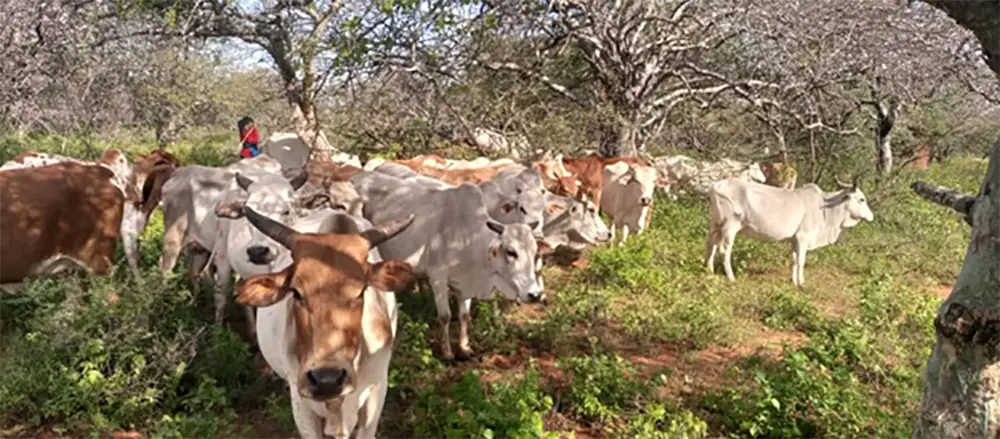
In 2018, an independent study revealed that 68% of AfriScout users improved pasture management thanks to our mapping technology. According to pastoralists, AfriScout helped them time herd movements and manage grazing pressure in ways that promoted healthier pastures. This begged an important question: if such results could be achieved through passive use of AfriScout, what might be possible with a more intentional, science-driven approach?
From Niche Practice to Large-Scale Transformation
Adaptive Multi-Paddock (AMP) grazing—also sometimes referred to as Holistic Planned Grazing—has shown remarkable results on private ranches, improving soil health, water retention, carbon sequestration, and biodiversity. Under AMP, herds are grazed at high densities for short periods, followed by long rest cycles, mimicking natural herd movements.
Johnson DC, Teague R, Apfelbaum S, Thompson R, Byck P. 2022. Adaptive multi-paddock grazing manage-
ment’s influence on soil food web community structure for: increasing pasture forage production, soil organic carbon, and reducing soil respiration rates in southeastern USA ranches. PeerJ 10:e13750 http://doi.org/10.7717/peerj.13750
While effective, AMP has historically been practiced on small, privately managed plots. Implementing it at the scale of communal rangelands—where multiple pastoral groups share vast territories—seemed impossible. Until now.
Innovating for Scale
With support of Dr. Astrid Heulin, veterinarian and passionate advocate of regenerative practices, AfriScout adapted AMP to specifically meet the needs and context of African Pastoralists, developing a unique training program in 2022. This program equips large pastoral groups to coordinate AMP practices across shared lands – at a scale 300 times the size of a typical private ranch.
In parallel, we designed AfriScout Regen, a specialized version of our app that uses satellite data and machine learning to guide pastoralists on where and when to move their herds. This innovation enables communities to apply AMP practices with precision across massive landscapes.
Early Impact
In April 2023, AfriScout launched its first Regen initiative in Ethiopia’s Oromia region, working with communities whose grazing lands had become severely degraded. Since then, we have partnered with 70 pastoral groups across Oromia, South Omo, and Somalia. These communities are now actively practicing AMP through AfriScout Regen, with the support of the soon-to-be-released app designed to enhance coordination, adherence, and monitoring.
A Global Milestone
Today, AfriScout Regen manages 1.5 million hectares of rangeland and one million animals, making it one of the largest regenerative grazing projects in the world—and the only of its scale applying AMP. In partnership with the Ethiopian government and local communities, we are also measuring and verifying the carbon sequestration impact of these practices. In April, the project was officially listed on Verra, a major step toward unlocking climate finance opportunities for pastoralist communities.
Looking Ahead
AfriScout Regen is demonstrating that what was once considered niche and small-scale can be transformed into a landscape-level solution with global significance. By combining indigenous knowledge, regenerative science, and cutting-edge technology, we are proving that pastoralists can lead the way in restoring degraded lands, capturing carbon, and sustaining biodiversity—at scale.