
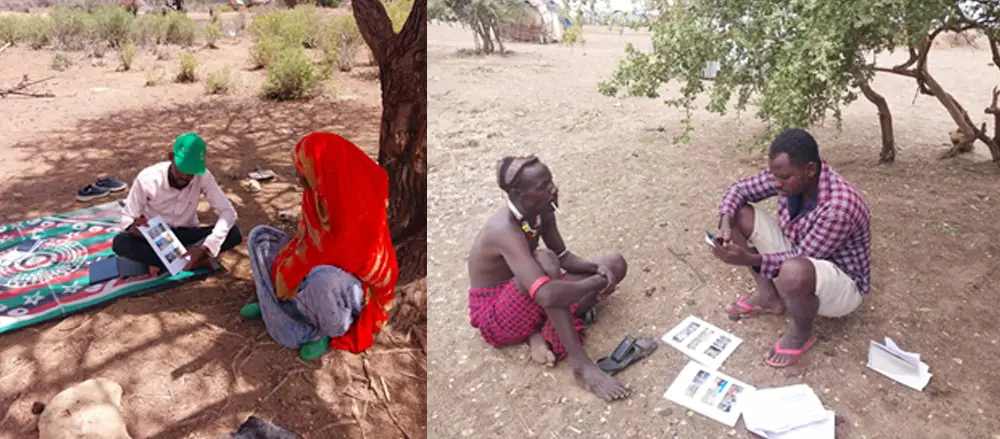
Causal Design’s two year mixed-methods impact evaluation funded by SPARC (Supporting Pastoralism & Agriculture in Recurrent & Protracted Crises) highlights the causal impacts of AfriScout’s work.
AfriScout Steward
AfriScout Steward is helping pastoralist families make smarter, more confident decisions about where to move their herds. Families who received training on the app were far more likely to rely on it as a trusted source of migration information, while still feeling it supported their traditional herding practices.
Although large differences in pasture quality or herd health were not detected in this study, many users reported that the app helped them locate better grazing areas. Most trained families ended up in places with sufficient pasture and felt confident about their herd’s condition—especially in a year with abundant rainfall.
The app also generated financial and social benefits. Families saved money on feed and scouting, earned more from healthier livestock, and felt less stress about
migration decisions. Importantly, the app broadened participation in decision-making, ensuring more voices—especially women and youth—were heard. Access to shared information helped reduce conflicts, while wildlife alerts improved safety and contributed to conservation outcomes.
Overall, AfriScout Steward is making a positive difference in how pastoralists manage their herds and land, even in ways that go beyond measurable data.
AfriScout Regen
The AfriScout Regen project has a big impact on how communities manage their grazing lands. Families who took part are much more likely to have a shared grazing plan and take action to improve grass quality. They also feel confident that their community could manage the land well.
Pastoralist’s really embraced the app’s advice and saw improvements in pasture quality. Even though satellite data didn’t show big changes, users said the grass was better and credited their new grazing practices.
The AfriScout Regen project is transforming how communities manage and regenerate their grazing lands. Families participating in the program were far more likely to develop shared grazing plans and take action to improve grass quality, with many reporting that their community was now confident in managing land collectively.
Pastoralists embraced the app’s guidance and reported noticeable improvements in pasture quality. While satellite data showed only modest changes, users consistently credited their new grazing practices with healthier, more abundant grass.
Herd health also improved. Families reported better livestock conditions, especially for cattle, and saw more milk and meat production. These changes led to higher incomes, lower costs, and better food security. Families felt more resilient and less stressed, with more time saved from reduced scouting and migration.
The program also helped reduce conflicts within and between communities. Better communication and less need to move around made things more peaceful. Wildlife encounters dropped, and some users noticed more wild animals returning to the area thanks to better land conditions.
Migration became easier, with families finding pasture and water more reliably. They didn’t need to travel as far, and they relied less on scouts, saving time and money.
In short, AfriScout Regen is helping communities take better care of their land and animals, leading to stronger livelihoods and more cooperation.
CONCLUSION:
This study underscores both the increasing vulnerability of pastoral livelihoods in the Horn of Africa and the urgent need for effective solutions like AfriScout.
- AfriScout Steward proved valuable in guiding migration decisions, earning high trust among users.
- AfriScout Regen in Ethiopia demonstrated clear, significant impacts across rangeland management, pasture quality, herd health, incomes, and overall pastoral well-being.
The success of both AfriScout Steward and AfriScout Regen highlights the transformative potential of collective action and adaptive grazing practices in improving both ecological health and human livelihoods.